
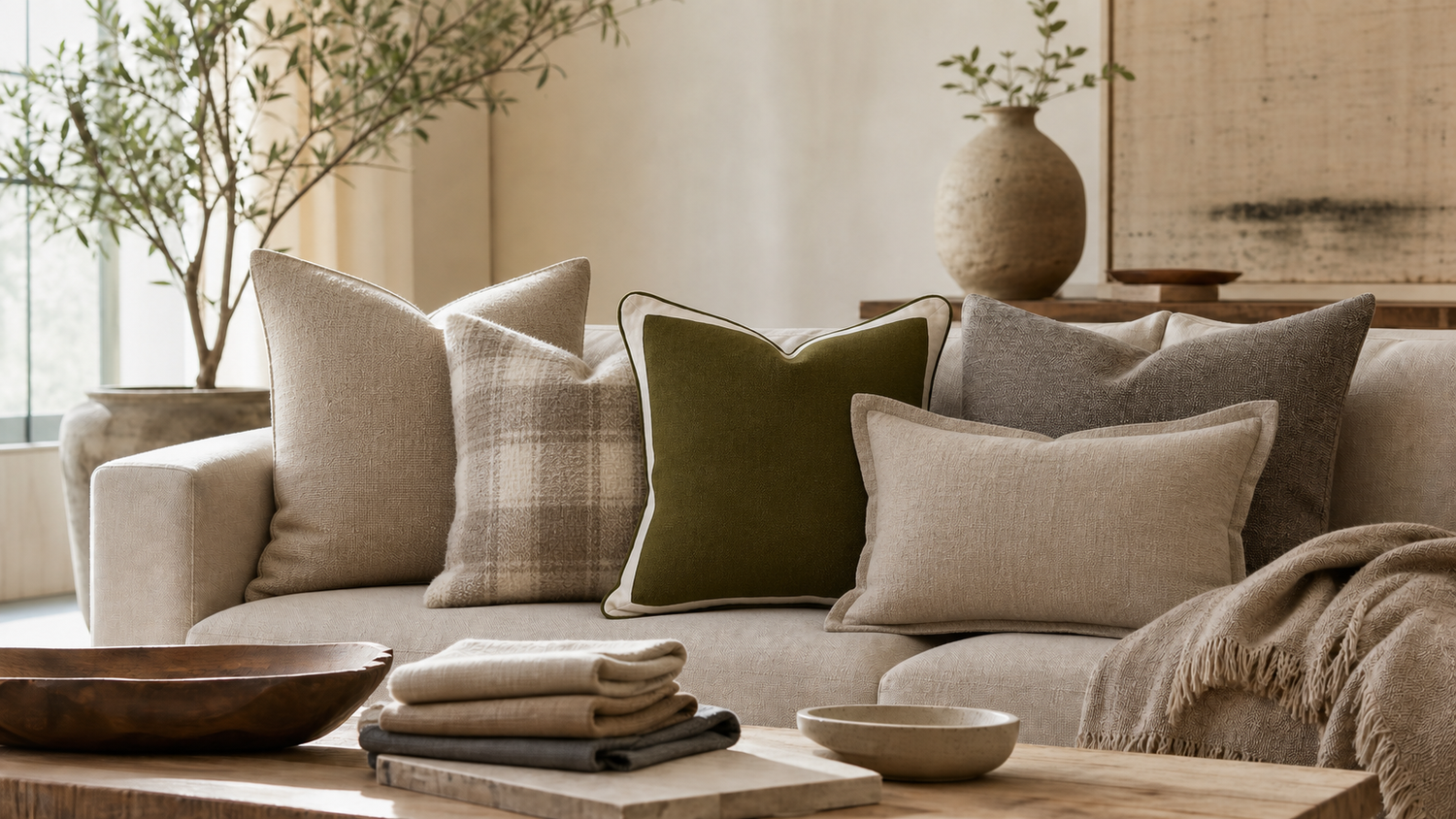
Throw pillows are often blamed when a living room starts to feel crowded, but the real problem is usually not the pillows themselves. It is proportion. Too many small cushions, too many competing fabrics, or too many pieces styled without a clear hierarchy can make even a beautiful sofa look fussy.
For an IdyllVie-style room, the goal is different. The room should feel calm, useful, tactile, and quietly elevated. Throw pillows should soften the line of a sofa, echo the natural materials around the room, and make the seat feel more inviting. They should not create work every time someone wants to sit down.
That is why the best throw pillow styling is usually more restrained than people expect. You need enough variation to create depth, but not so much that the sofa becomes visually busy. Once you understand a few practical rules around count, scale, colour, and texture, the whole arrangement becomes easier.
The Quick Answer
If you want the short version, start here:
- use two to four throw pillows on most standard sofas
- begin with larger square pillows at the corners, then add one smaller square or one lumbar in front
- keep your palette tight, especially if the sofa is already textured or the room is layered
- mix texture more than colour when you want the look to stay calm
- remove one pillow before you think you have finished if the arrangement starts to feel crowded
That last rule matters more than it sounds. The easiest way to avoid a busy sofa is to stop one step earlier.
Why Sofas Start Looking Busy
Most cluttered pillow arrangements come from one of four mistakes:
- every pillow is the same size
- every pillow tries to be the statement piece
- there are too many colours in a limited space
- the arrangement ignores the depth and width of the sofa itself
Current design guidance from The Spruce, Better Homes & Gardens, and Homes & Gardens is surprisingly aligned on this point: good pillow styling depends on proportion, not abundance. In other words, a sofa looks finished when the pillows feel edited.
That matters especially in a neutral living room. When the palette is soft and tonal, every choice becomes more visible. A bulky bouclé cushion, a dark wool square, or an oversized lumbar can look beautiful, but only if the surrounding pillows support it instead of competing with it.
Start with the Sofa, Not the Pillow
Before choosing fabrics or colours, look at the sofa shape itself.
Tailored sofas need restraint
If the sofa has straight arms, a crisp silhouette, or a more formal line, it usually needs fewer pillows. These shapes already have structure. Adding too many accessories can blur that clean architecture. In most cases, two larger corner pillows plus one lumbar is enough.
Deep lounge sofas can carry more volume
If the sofa is deeper and more relaxed, it can handle a fuller arrangement because the seat visually asks for softness. This does not necessarily mean more pillows. It can simply mean slightly larger ones, or a mix with more loft and texture.
Sectionals need a zone-based approach
Sectionals are where people often overdo it. Instead of styling every seat, think in zones. Usually the end corners and one central point are enough. If every corner gets a full stack, the sofa stops feeling usable.
How Many Throw Pillows Usually Looks Right?
There is no single number that works in every room, but there is a range that keeps most sofas balanced.
| Sofa type | Best starting count | What usually works best |
|---|---|---|
| Small loveseat | 2 pillows | One larger pillow at each end |
| Standard three-seat sofa | 3 pillows | Two larger squares plus one lumbar or smaller accent |
| Deep sofa | 4 pillows | Two larger squares, one medium accent, one lumbar |
| Large sectional | 4 to 6 pillows | Grouped by corner rather than spread across every seat |
Better Homes & Gardens' current sofa guidance still points toward two to four pillows for many sofas, while The Spruce notes that larger pieces may support more when grouped thoughtfully. The useful takeaway is not the exact number. It is that seating space still needs to feel available.
If someone has to move half the arrangement before sitting down, the sofa is over-styled.
The Easiest Pillow Formula for a Calm Sofa
When in doubt, use a simple shape hierarchy:
- two square pillows at the back corners
- one smaller square or one lumbar in front
- optional fourth pillow only if the sofa is deep enough to carry it
This works because it gives the eye a clear order. Larger shapes anchor the ends. The smaller front pillow softens the arrangement and adds dimension. Homes & Gardens' late-2025 couch-styling guidance supports this kind of proportion-first approach, especially the idea that most sofas need corner pillows closer to 20 inches than 16 inches.
Small pillows are one of the quickest ways to make a sofa look busy. They read decorative without offering enough visual weight. On most adult-size sofas, they can look like accessories that got lost.
Choose Size Before Pattern
Pillow styling gets easier when you settle scale first.
For most sofas, start around 20 inches
Current styling coverage from both The Spruce and Homes & Gardens consistently treats 20-inch squares as a strong default for sofa corners. That size has enough presence to frame a seating area without looking stiff.
If your sofa is compact, you may scale down slightly. If it is oversized, you may want something larger. The point is to match the sofa, not the store display.
Use lumbar pillows to reduce visual noise
A lumbar pillow is one of the best tools for a refined arrangement because it adds shape contrast without adding bulk. It also keeps the styling lower and calmer than stacking multiple medium squares in front.
On a neutral sofa, one long lumbar can do the work that two smaller accent pillows would otherwise do.
Mix sizes, but not randomly
The best combinations look intentional. That often means one clear large size, one supporting size, and no unnecessary extras. If you use three different square sizes plus a lumbar, the arrangement often starts feeling restless.
Texture Does More Than Colour
If you want the sofa to feel layered but not loud, vary texture more than colour.
That could mean pairing:
- a washed linen square with a brushed wool blend
- a smooth cotton pillow with a lightly nubby weave
- a soft bouclé accent with a flatter woven lumbar
This approach suits the live IdyllVie home direction well. The brand language and current home assortment lean natural, tactile, and artisan rather than glossy or trend-heavy. In that setting, texture is what creates depth. You do not need six colours or high-contrast prints to make the arrangement feel considered.
The Spruce's 2025 pillow-styling coverage also reinforces this point: mixing materials creates richness, but staying within a cohesive colour family keeps the sofa from feeling chaotic.
How to Keep the Colour Palette Calm
The easiest palette for a quiet-luxury sofa is tonal rather than contrasting.
Think in families such as:
- cream, flax, sand, and warm taupe
- oat, stone, mushroom, and charcoal
- soft ivory, greige, and one muted earth accent
If the sofa itself is neutral, limit yourself to one stronger accent note at most. That accent could come through a darker wool pillow, a stitched stripe, or a subtle handmade pattern. Everything else should support it.
When pattern works
Pattern is not the enemy. Competing pattern is.
If you want pattern, let one pillow carry it and keep the others quieter. A stripe, block print, or tonal plaid can work beautifully when the scale is controlled and the surrounding textures are simpler.
When to skip pattern altogether
Skip obvious pattern if:
- the sofa fabric already has visible texture
- the room includes patterned curtains, rugs, or artwork
- the arrangement already uses multiple pillow shapes
In those cases, pattern usually adds noise faster than interest.
Styling Combinations That Usually Work
If you want a practical starting point, these are reliable combinations:
Option 1: The easiest refined mix
- two 20-inch square pillows
- one 14 x 20 or 14 x 24 lumbar
This is the safest formula for most standard sofas and one of the best if you want the room to feel clean.
Option 2: The softer layered mix
- two 20-inch square pillows
- one 18-inch accent square
- one lumbar
This works best on a deeper sofa where you want a little more fullness without losing order.
Option 3: The minimal sofa edit
- one square pillow on each end
- no center accent unless it is truly needed
This is often the right answer for smaller sofas, tailored silhouettes, or homes that already have plenty of texture elsewhere.
A Simple Checklist Before You Finish the Arrangement
Use this checklist before you call the sofa done:
- can someone sit down without removing multiple pillows?
- are the largest pillows clearly anchoring the arrangement?
- is one pillow acting as the visual focal point while the others support it?
- are the colours close enough to feel cohesive?
- is texture doing more work than pattern?
- does the arrangement suit the sofa width and depth?
- would removing one pillow improve the look?
If the answer to that last question is yes, remove it.
How to Style Throw Pillows on a Bed Without Repeating the Sofa Formula
Even though this article focuses on sofas, many people want a coordinated look across living and sleeping spaces. That does not mean the pillow formulas should match exactly.
Better Homes & Gardens' bed styling guidance suggests that bed pillows can be more layered than sofa pillows because the surface is larger and more symmetrical. But restraint still matters. A bed generally looks better when decorative pillows create one composed front layer rather than a pile of unrelated accents.
For a calmer bedroom, one oversized lumbar or one pair of decorative pillows is often enough over standard sleeping pillows and Euros. If you love a layered bed, make sure the decorative pillows still echo the room palette instead of competing with the bedding.
The same logic applies as it does on a sofa: the room should feel finished, not overfilled.
The Sustainable Styling Angle
There is also a practical sustainability benefit in editing your pillow mix. Fewer, better-made pillows are easier to maintain, easier to store seasonally, and more likely to stay in use for years. A carefully chosen linen, cotton, wool, or alpaca-blend pillow does more for a room than a pile of trendy fillers that flatten quickly.
That idea fits IdyllVie's broader brand position. Quiet luxury at home is rarely about adding more. It is about choosing tactile, lasting pieces that make daily life feel softer and more intentional.
When you style a sofa with that mindset, the arrangement naturally becomes less busy. You stop filling space for the sake of decoration and start choosing pillows that actually belong there.
The Best Rule to Remember
If you only keep one principle from this guide, keep this one: style the sofa until it feels complete, then edit once.
Usually that means:
- fewer pillows than the showroom display
- larger pillows than budget decor stores often suggest
- more texture and less contrast
- one clear focal point instead of multiple statements
That is how a sofa stays inviting. It still feels soft. It still feels layered. It just does not feel crowded.
In a calm home, the best throw pillows should look like they arrived on purpose and stayed for a reason.
FAQ
How many throw pillows should be on a standard sofa?
For most standard sofas, three pillows is an excellent place to start: two larger square pillows and one lumbar or smaller accent. Some larger or deeper sofas can carry four comfortably.
What size throw pillows look best on a couch?
For many full-size sofas, 20-inch square pillows are the most reliable starting point for the corners. Smaller accent sizes or a lumbar can then layer in front if needed.
How do I make throw pillows look less cluttered?
Use fewer pillows, choose larger anchor pillows, keep the palette cohesive, and let texture do more work than pattern. Clutter usually comes from too many small or competing pieces.
Should all throw pillows match?
No. They should relate, not match perfectly. The best arrangements usually mix texture, scale, or shape while staying within a connected colour story.
Are lumbar pillows better than square accent pillows?
Often, yes, when you want the sofa to look calmer. A lumbar pillow introduces shape contrast without adding as much bulk as multiple front square pillows.
How can I style neutral throw pillows so they still look interesting?
Mix linen, cotton, wool, bouclé, or brushed finishes in neighbouring tones such as cream, flax, taupe, stone, and charcoal. Texture and subtle contrast keep neutrals from looking flat.












0 comentarios