
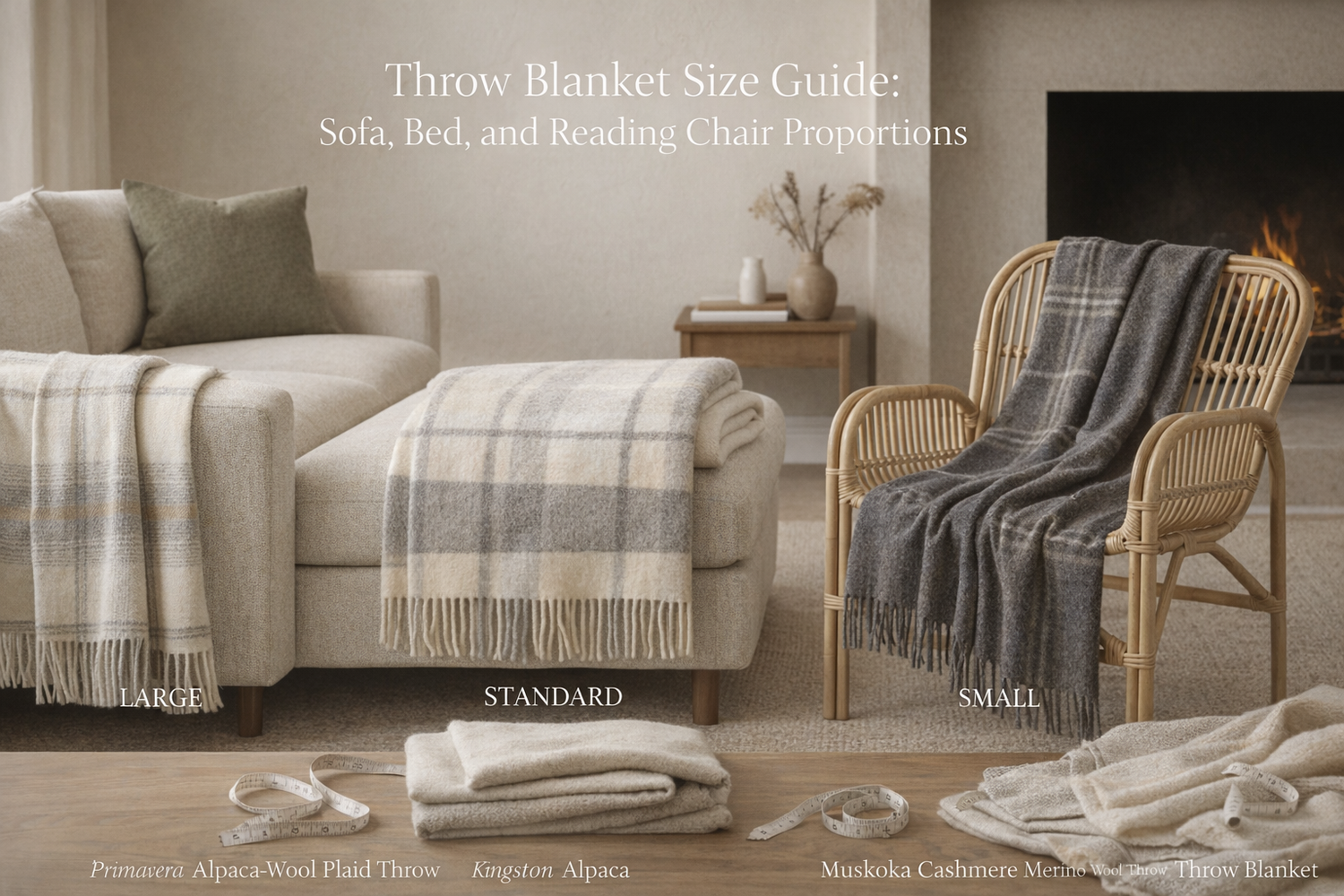
Choose the coverage first
For a chair or a solo sofa throw, 50 x 60 inches is a useful starting point. For more coverage, compare larger sizes with the space you want to cover. On a bed, decide whether you want an accent across the foot or a blanket that covers the mattress.
Measure the furniture and the drop you want before choosing. The size ranges in this guide are styling examples, not the listed dimensions of every throw.
Prefer an alpaca blend? The Primavera Alpaca-Wool Plaid Throw combines 55% alpaca with 45% wool. The Kingston Alpaca and Lambswool Throw pairs 55% alpaca with 45% lambswool in a charcoal, taupe and ivory plaid.
The right throw blanket should feel intentional the moment it lands in a room. It should soften a sofa without swallowing it, add warmth to a reading chair without trailing awkwardly on the floor, and bring texture to the end of a bed without looking undersized. That sounds simple, but most sizing mistakes happen because people shop by colour or fibre first and leave proportion for later.
Think about how you use the room as well as how it looks. A throw you reach for every evening needs enough coverage to keep you comfortable; one folded over an armchair can be smaller and still bring colour and texture to the space.
That means a size guide should not stop at a single standard measurement. You need to know how the blanket will be used, how much drape you want, what piece of furniture it is sitting on, and whether the throw is meant to be grabbed nightly or styled as a finishing layer that still needs to function.
The Quick Answer
If you want the shortest version, use these defaults:

- choose around 50 x 60 inches for most sofas and occasional chairs
- size up to around 55 x 70 or 55 x 78 inches when you want fuller drape or better coverage at the foot of a bed
- move toward 60 x 80 inches only when the throw is meant to cover more than one person or make a stronger bed-layer statement
- treat a throw as an accent layer on a queen or king bed, not a primary blanket
Those ranges cover most real-world rooms well. From there, material and styling become much easier to judge.
What Counts as a Throw Blanket?
A throw blanket sits between decor and utility. It is smaller than a standard bed blanket, easier to move around the house, and usually chosen for both touch and visual finish. Southern Living's current blanket-sizing guidance still puts the common throw range around 50 by 60 inches, which is why so many throws feel right on a sofa or chair instead of reading like full bedding.
That standard size is only the starting point, though. A larger throw can make more sense when the furniture is deep, when you want more wraparound comfort, or when the blanket needs to span the foot of a bed with enough drop to look deliberate. In other words, a throw is defined less by one exact number and more by how it layers in a room.
Start with the Use Case Before the Measurement
People often ask, "What is the standard throw blanket size?" The better question is, "Where will this throw live most of the time?"
For a sofa
On a sofa, the throw has to do three jobs at once. It should look soft from across the room, sit neatly when folded or draped, and still be big enough to pull over your legs during a cool evening. That is why the classic 50 x 60 size works so often. It gives visible drape without bunching excessively on a standard three-seat sofa.

If your sofa is deep, wide, or very low-slung, a slightly larger throw often looks more balanced. Homes & Gardens' current sofa-styling advice still emphasizes that a throw should add softness and warmth while staying in proportion with the seating. In practice, that means a skimpy throw can disappear visually, while one that is too large can make the sofa feel cluttered.
For a reading chair
A reading chair usually benefits from the same 50 x 60 range, but the styling goal is slightly different. Here, you want enough length to drape over an arm and still leave a usable section across your lap. If the chair is upright and compact, an oversized throw can feel bulky. If the chair is broader or cocoon-like, a slightly larger throw can look luxurious instead of messy.
This is where texture often matters as much as width. A plush or brushed throw with visible fringe will look fuller on a chair than a flatter weave in the same dimensions.
For the end of a bed
The foot of the bed is where many throw blankets start looking too small. Better Homes & Gardens' current bed-layer guidance for wool and accent blankets makes the distinction clear: a throw is not the same thing as a full bed blanket. On a twin or full bed, a throw can sometimes feel substantial enough when folded with intention. On a queen or king bed, it usually works best as a horizontal accent layer rather than a blanket meant to span the full width.
That is why larger throw dimensions, such as 55 x 78 or 60 x 80, often perform better on beds. They give you enough visual presence to anchor the foot of the bed while still reading as an accent rather than a duvet replacement.
A Practical Size Chart
| Placement | Best starting size | When to size up | What it should look like |
|---|---|---|---|
| Reading chair | 50 x 60 inches | If the chair is extra wide or you want fuller wrap | A soft arm drape with enough fabric left for actual use |
| Standard sofa | 50 x 60 inches | If the sofa is deep or shared often | Visible drape without pooling heavily on the floor |
| Large sofa or sectional corner | 55 x 70 to 60 x 80 inches | When two people may use it or the seating is oversized | More generous coverage with a relaxed, intentional fall |
| Twin or full bed accent | 50 x 60 to 55 x 70 inches | If you want stronger visual width at the foot | A folded or lightly spread accent band across the lower third |
| Queen or king bed accent | 55 x 78 to 60 x 80 inches | If the bed is tall, wide, or heavily layered | Enough width to feel grounded, not like a narrow scarf |
The important point is that furniture scale changes how the same throw reads. A standard throw can look generous on a chair and undersized on a king bed.
Why Material Changes How Size Feels
Two throws with the same dimensions can look completely different once you factor in fibre, weight, and surface texture.
Cotton throws read cleaner and flatter
The current IdyllVie product page for The Cotton Weave Blanket describes it as 100 percent cotton with a medium-weight, breathable feel. That kind of construction usually lies flatter and cleaner, which means it often suits modern sofas, summer layering, and homes that prefer a quieter line. Because cotton throws tend to collapse less dramatically than fuzzy or lofty fibres, they can look slightly more tailored at the same size.
That is useful if you want a throw that stays neat when folded over a sofa arm or across the lower corner of a bed.
Alpaca and wool throws read softer and fuller
IdyllVie's current Primavera Alpaca-Wool Plaid Throw is listed at 55 x 78 inches in a heavy 950 GSM weave made from 55 percent alpaca wool and 45 percent wool. That is a helpful real-world benchmark because it shows how a slightly larger dimension paired with denser fibre can create a more luxurious drop.
On a sofa, that size can reach farther down the front and still look purposeful. On a bed, it reads more like a true finishing layer than a narrow accent. This is an inference from the listed dimensions and fibre weight, but it is a useful one: heavier, loftier throws usually need a little more room to show their character properly.
Chunky or highly textured throws need visual breathing space
Large knit stitches, tassels, boucle surfaces, and exaggerated fringe all increase the visual footprint of a blanket. Even when the measurement is standard, the throw can appear larger because the texture claims more attention. That is why heavily textured throws often look best when the rest of the styling stays simple.
How to Choose the Right Throw for a Sofa
If the throw will live mostly in the living room, start with the sofa depth and arm shape.
Straight-arm or tailored sofas
These usually suit a medium-size throw in the 50 x 60 range because the structure is already crisp. A neat fold or one relaxed corner drape is often enough. If you add an oversized blanket here, the room can tip from refined to heavy very quickly.
Deep lounge sofas
These often benefit from extra length. A 55 x 70 or 55 x 78 throw tends to feel more in scale, especially if you actually want to use it while sitting. The key is to let part of the blanket drape naturally while keeping some of the cushion visible.
Sectionals
With sectionals, placement matters more than exact category. A blanket at the corner seat usually needs more dimension than a blanket on a terminal arm because it has to bridge a broader visual zone. If the sectional is big enough for shared use, that is one of the few cases where moving toward 60 x 80 can make sense.
How to Choose the Right Throw for a Bed
A throw blanket on a bed should look layered, not accidental.
Twin and full beds
A standard throw can often work here, especially when folded into thirds or placed across the lower section. Better Homes & Gardens' styling approach continues to support this kind of deliberate fold because it adds texture without trying to impersonate a second duvet.
Queen and king beds
This is where many shoppers underestimate width. A narrow throw on a large bed can look like an afterthought. A larger throw, or one with more visible weight, usually lands better. IdyllVie's 55 x 78 alpaca-wool size is a good reference point for the kind of proportion that can still hold its own on a larger mattress when used as a finishing layer.
Taller beds and layered bedding
If you already use a duvet, quilt, and decorative pillows, the throw needs enough scale to stand up to those layers. In a tall upholstered bed, sizing up often helps the throw remain visible instead of disappearing into the bedding stack.
Styling Methods That Make Size Look Better
Good size choice and good styling work together. A throw that is technically correct can still look wrong if it is placed without intention.
The half-fold sofa drape
This is the easiest everyday method. Fold the throw lengthwise once, then drape it over one sofa arm or corner. This works especially well with standard 50 x 60 throws because it leaves enough drop to feel relaxed without touching the floor too aggressively.
The bed-band fold
For queen and king beds, folding the throw into a broad horizontal band at the foot usually looks more polished than spreading it flat. It keeps the blanket from feeling too small and lets the texture show.
The loose-chair cascade
On a reading chair, let the throw start behind the back or over one arm, then fall onto the seat with a little spare fabric showing. Real Simple's current blanket-folding guidance still supports loose but controlled draping because it looks lived-in without appearing careless.
A Checklist Before You Buy
Before you commit to a throw blanket size, check the following:
- where the blanket will live most of the time
- whether it is mainly decorative, mainly functional, or expected to do both
- the width and depth of the furniture it will sit on
- whether the room is visually minimal or already heavily layered
- the fibre and weight of the throw
- whether fringe or texture increases the visual bulk
- whether you want one-person comfort or enough coverage to share
- whether the throw is meant to accent a bed or actually cover it
If you answer those eight questions first, the right size usually becomes obvious.
The IdyllVie Way to Think About Throw Proportion
The live IdyllVie home assortment offers a useful way to frame the decision because it mixes breathable cotton with denser, more tactile natural-fibre throws. That range suggests a simple principle: the best throw blanket is not necessarily the biggest one. It is the one whose scale fits the room, whose fibre fits the season, and whose texture fits the mood of the space.
If you want a quiet, practical layer for everyday use, a cotton throw in a standard proportion is often enough. If you want a more luxurious accent for a bed or a larger sofa, the slightly bigger alpaca-wool approach makes more sense. Neither is universally better. The room decides.
That is also the sustainable answer. A well-sized throw gets used more often, moved around the home more naturally, and replaced less impulsively than a blanket that only looked good in a product photo.
The Best Default for Most Homes
For most homes, the safest first choice is a throw around 50 x 60 inches for chairs and standard sofas, then a move up to roughly 55 x 78 inches when you want stronger drape or a more substantial bed accent. That is the simplest way to balance comfort, styling, and proportion without overcomplicating the decision.
If you are between sizes, let the furniture scale and the blanket weight break the tie. Lighter cotton weaves can stay smaller and still look composed. Loftier wool or alpaca blends often benefit from a slightly more generous dimension.
The most beautiful throw blankets do not fight the room. They complete it.
FAQ
What is the standard throw blanket size?
The most common starting point is around 50 x 60 inches. That size works well for many sofas and chairs because it offers usable coverage without reading like full bedding.
Is a throw blanket big enough for a queen bed?
Usually only as an accent layer, not as a full bed covering. On a queen bed, a throw looks best folded at the foot or used as a decorative horizontal layer rather than spread across the whole mattress.
What throw blanket size looks best on a sofa?
For most standard sofas, 50 x 60 inches is the best default. If the sofa is very deep or oversized, moving up to roughly 55 x 70 or 55 x 78 inches can look more balanced.
How do I know when to choose an oversized throw?
Choose an oversized throw when the furniture is large, when two people may use it, or when you want fuller drape at the foot of a bed. Oversized throws also make sense for denser fibres that benefit from a more generous drop.
Does fabric change how big a throw blanket looks?
Yes. Cotton throws often look cleaner and flatter, while alpaca, wool, boucle, or chunky knit throws usually read fuller and more substantial at the same size.
Can I use one throw blanket in multiple rooms?
Yes, as long as the size is versatile enough for the way you live. A standard throw is usually the easiest to move between a sofa, chair, and the lower corner of a bed.












0 comments