
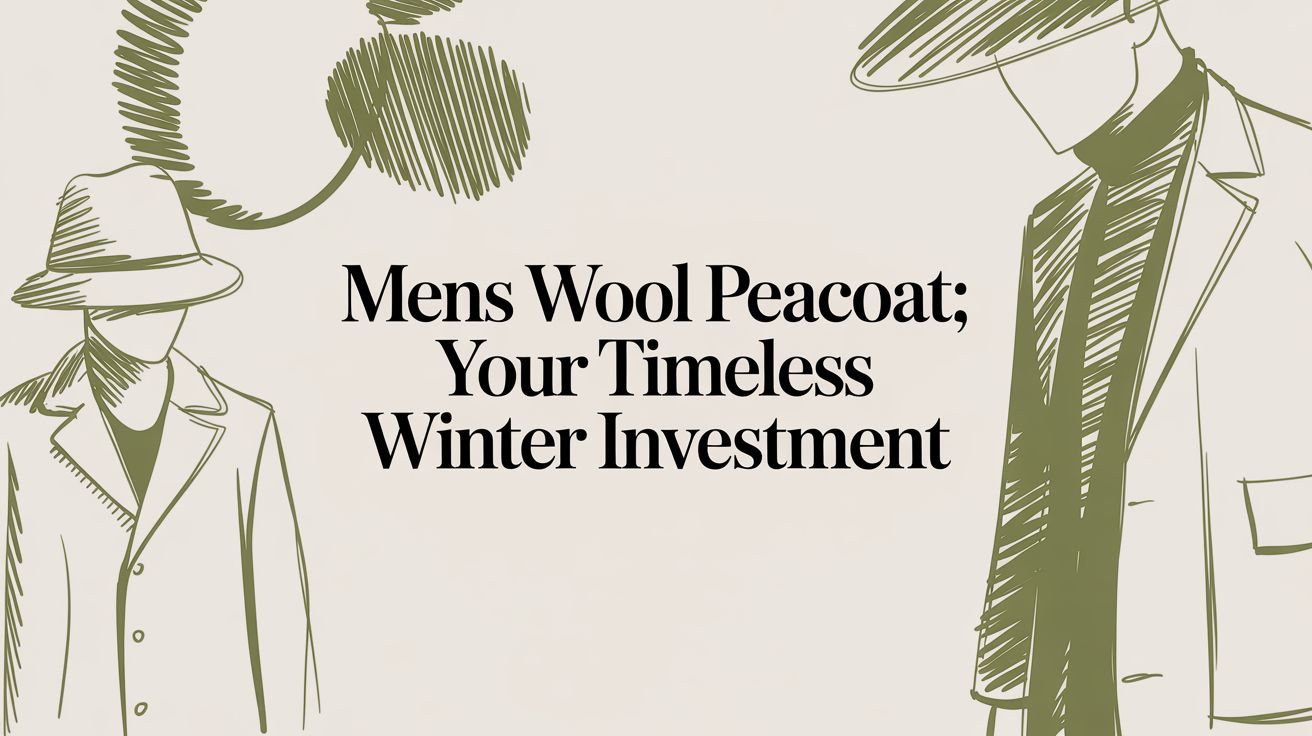
Vous êtes probablement dans la même situation que de nombreux acheteurs canadiens à l'arrivée de l'automne. Votre ancien manteau d'hiver existe toujours, mais il ne répond plus à vos besoins. Il est peut-être trop encombrant pour le travail, trop décontracté pour un dîner, trop léger face au vent, ou trop synthétique pour la manière dont vous souhaitez acheter aujourd'hui.
C'est là qu'un pardessus en laine pour homme trouve sa place. Il se situe dans une rare zone intermédiaire. Il a l'air raffiné sans être précieux, garde mieux sa forme que de nombreuses doudounes souples, et porte une histoire d'utilisation intensive plutôt qu'un design dicté par les tendances. Pour un acheteur qui veut un seul manteau capable de passer d'un trajet quotidien à une promenade le week-end, cela compte.
La meilleure raison de prendre un pardessus au sérieux est plus simple. C'est l'un des rares vêtements d'hiver qui récompense la patience. Si la laine est bonne, si la coupe permet de superposer des couches, et si la construction est honnête, il ne devient pas obsolète après une saison. Il devient le manteau que l'on choisit année après année.
Une icône durable pour les hivers canadiens
Un bon manteau d'hiver est testé dans les moments ordinaires, pas sous les éclairages d'une salle d'exposition. On le ressent quand on attend le tramway sous la grêle, quand on sort du bureau face à un vent mordant, ou quand on promène le chien avant le lever du soleil, alors que le trottoir est à moitié gelé, à moitié boueux. Dans ces moments-là, le style seul ne suffit pas. Il faut de la chaleur, de la liberté de mouvement et de la confiance.
C'est pourquoi le caban a perduré si longtemps. Il n'a pas été inventé comme décoration. Le caban en laine pour homme est né de l'usage naval, où le froid, le vent, le sel et l'exposition étaient des réalités quotidiennes. Cette origine pratique se retrouve encore dans les meilleures versions du manteau aujourd'hui. La forme est épurée, mais l'objectif est sérieux.
Au Canada, cet héritage prend une importance supplémentaire. Le caban en laine pour homme, dont les racines remontent aux conceptions néerlandaises de pijjekker du début des années 1800, est entré dans l'histoire maritime canadienne grâce à son adoption par la Marine royale canadienne. Pendant la Seconde Guerre mondiale, les cabans fabriqués à partir de lourde laine Melton de 30 oz étaient l'équipement standard de plus de 100 000 hommes servant dans les conditions de l'Atlantique Nord qui descendaient souvent en dessous de -20 °C, comme le note l'histoire du caban de Saint James.
Un manteau aux racines navales n'est pas automatiquement un bon manteau. Mais un design qui a survécu à l'usage naval part généralement avec les bonnes priorités.
Cette histoire est importante car elle explique pourquoi le caban semble toujours approprié dans une garde-robe canadienne. Il n'essaie pas d'imiter l'utilité. Il a été construit à partir de l'utilité. Le large col, la laine dense et le double boutonnage proviennent tous de la même question : comment conserver la chaleur quand le temps tente de l'emporter ?
Pour un acheteur réfléchi, cela fait du caban plus qu'un choix de style. C'est une réponse utile à un problème familier. Vous voulez moins de vêtements, de meilleurs matériaux et des pièces qui vieillissent avec dignité. Un caban bien fait répond à ce cahier des charges avec une facilité inhabituelle.
L'anatomie d'un caban intemporel
Un vrai caban est facile à reconnaître une fois que l'on sait ce qu'il faut chercher. Les détails ne sont pas aléatoires. Presque toutes les caractéristiques ont un rôle à jouer, et les meilleures versions modernes respectent encore cette logique.

La fermeture avant et le col
La première caractéristique qui attire l'attention est le double boutonnage. Ce n'est pas seulement une tradition visuelle. Il confère au manteau un chevauchement de tissu sur la poitrine, ce qui contribue à protéger le torse du vent et donne à l'avant une tombée plus structurée. Lorsqu'il est boutonné correctement, il offre une sensation plus sûre qu'une simple fermeture à un seul boutonnage.
Ensuite, il y a le large col et les revers. Sur un vrai caban, le col doit faire plus que de rester plat et d'avoir fière allure. Il doit également pouvoir être relevé facilement lorsque le vent se lève. Un col résistant aux tempêtes transforme le manteau d'élégant à utile en quelques secondes.
Recherchez ces signes d'une bonne conception frontale :
- Des revers équilibrés qui restent plats lorsqu'ils sont portés ouverts et ne s'affaissent pas vers l'intérieur.
- Des boutons placés à dessein, afin que le manteau se ferme proprement sans tension.
- Un col avec du corps, et non un morceau de tissu mou qui se plie maladroitement.
Les boutons, les poches et la longueur
Les boutons en disent étonnamment long sur un manteau. Les versions traditionnelles utilisent souvent des boutons de style ancre, un clin d'œil à l'histoire maritime, mais ce qui compte le plus, c'est la substance. Ils doivent être solidement fixés, suffisamment épais pour résister à une utilisation répétée et suffisamment grands pour être manipulés avec des mains gantées.
Les poches fendues sont également importantes. Elles sont inclinées pour le confort, faciles à y glisser les mains et pratiques par mauvais temps. Pendant les hivers ontariens, la courte longueur et les poches fendues du caban sont particulièrement utiles, réduisant les risques d'accrocs sur la glace et la saleté urbaine, tout en s'associant aussi facilement avec des bottes robustes qu'avec des chaussures de ville, comme décrit dans l'aperçu du caban de L.L.Bean.
Règle pratique : Si un caban a l'air élégant sur un cintre mais que ses poches s'évasent, que le devant gondole ou que le col ne se tient pas correctement, le design est décoratif plutôt que fonctionnel.
La longueur est un autre point de confusion courant. Un caban est intentionnellement plus court qu'un pardessus. Il se situe généralement autour du haut de la cuisse ou de la hanche, selon la coupe. Cette ligne plus courte vous offre une plus grande liberté de mouvement au quotidien, en particulier lorsque vous conduisez, faites la navette ou montez les escaliers.
Les détails de construction cachés
La qualité du manteau se révèle souvent dans les parties que les gens n'inspectent pas assez.
Un meilleur caban comprend généralement :
| Détail | Ce qu'il faut vérifier | Pourquoi c'est important |
|---|---|---|
| Coutures | Des coutures propres et régulières, sans plissures | De bonnes coutures aident le manteau à conserver sa forme dans le temps |
| Doublure | Doublure lisse et solide qui ne se tord pas | Facilite la superposition et réduit la friction |
| Ourlet | Poids et structure au bord inférieur | Empêche le manteau de paraître fragile |
| Boutons | Fixation solide et matériau robuste | Zone très sollicitée qui cède souvent en premier |
| Construction des épaules | Ligne nette sans affaissement | Donne au manteau sa structure masculine |
Certains cabans comportent également une fente arrière ou une forme à l'arrière pour faciliter le mouvement. Cela peut améliorer le confort, surtout si vous marchez souvent ou portez des tricots plus épais en dessous. Ce qui compte, c'est l'équilibre. Un caban doit être ajusté, mais jamais trop serré.
Le moyen le plus rapide de distinguer un vrai caban d'une imitation de mode est de poser une question : chaque caractéristique visible semble-t-elle résoudre un problème ? Si la réponse est oui, vous êtes probablement en présence d'un manteau qui mérite d'être pris en considération.
Décrypter la laine pour une chaleur et une qualité durables
Un caban gagne sa place dans une garde-robe canadienne au niveau du tissu. Deux manteaux peuvent paraître presque identiques sur un écran, mais l'un bloquera le vent vif du lac tandis que l'autre semblera décoratif après dix minutes à l'extérieur. C'est la laine qui crée cette différence. C'est la barrière, l'isolation et une grande partie du caractère à long terme du manteau.

Ce que fait réellement la laine épaisse
Le caban classique était construit autour d'un tissu de laine dense, le plus souvent du Melton ou du Kersey. Ces tissus sont serrés et très finis, ce qui leur confère une surface compacte et un toucher protecteur. Si un pull doux laisse passer l'air comme une moustiquaire ouverte, le Melton agit davantage comme un mur bien isolé. L'air circule toujours, mais beaucoup plus lentement.
Cette densité est importante dans les hivers côtiers et urbains canadiens, où le vent rend souvent le froid plus vif que ne l'indique le thermomètre. Le guide du caban de Gentleman's Gazette note que les cabans traditionnels étaient couramment fabriqués à partir de laine Melton substantielle parce que le tissu offre une réelle protection contre le vent et les conditions humides. En termes pratiques, la laine dense retient une couche d'air immobile près du corps et résiste à la perte de chaleur rapide qui rend les manteaux de mode plus légers décevants à l'extérieur.
Comprendre le poids sans jargon
Le poids du tissu est souvent exprimé en 24 oz, 30 oz ou gsm, et ces chiffres peuvent sembler abstraits. Une façon plus simple de les interpréter est de considérer le poids comme un indice de la quantité de matière qui travaille pour vous. Dans un caban, un tissu plus lourd offre souvent une meilleure résistance au vent, un tombé plus net et une meilleure tenue au fil des années d'utilisation.
Le poids seul ne dit pas tout. Un tissu de poids moyen bien fait peut être plus performant qu'un tissu lourd avec un tissage lâche ou une mauvaise finition. Cependant, si un caban est commercialisé pour l'hiver et que le tissu semble fin, mou ou presque comme une chemise, c'est généralement un signe avant-coureur.
| Type de laine | Poids typique (oz/gsm) | Chaleur & Isolation | Résistance à l'eau | Durabilité |
|---|---|---|---|---|
| Laine Melton | 24-32 oz / 670-900 gsm | Dense et protectrice contre le vent | Naturellement bonne grâce au tissage serré et à la lanoline | Élevée |
| Laine Kersey | Tissu lourd, de style naval | Chaleur forte avec un toucher légèrement différent | Bonne | Élevée |
| Mélange Mérinos | Varie selon le fabricant | Toucher plus doux pour un port quotidien plus facile | Modérée à bonne, selon la finition | Modérée à élevée |
| Mélange laine-synthétique | Souvent dans la gamme de poids d'un caban | Peut toujours être chaud si la teneur en laine est élevée | Varie selon le traitement | Souvent meilleure résistance à l'abrasion |
Utilisez ce tableau comme un premier filtre, non comme un verdict final. La meilleure approche reste de toucher le tissu, de le presser légèrement et de voir s'il reprend sa forme avec de la substance.
Les types de laine et leur ressenti
Les différentes fibres de laine modifient la façon dont un caban se porte au fil du temps.
La laine vierge a généralement plus de ressort et de résilience. Elle a tendance à conserver un aspect net et structuré. Les mélanges mérinos sont plus fins et plus lisses, ce qui peut rendre le port quotidien plus confortable, en particulier pour les hommes sensibles aux laines plus rêches. Si vous souhaitez avoir une idée plus claire du comportement des fibres plus fines dans les vêtements d'extérieur, ce guide sur une veste en laine mérinos est un complément utile. La laine recyclée mérite une sérieuse considération pour un acheteur conscient. Lorsqu'elle est bien traitée et finie, elle peut offrir de solides performances avec une empreinte matérielle réduite. Les mélanges cachemire ajoutent de la douceur, mais trop peuvent estomper le caractère ferme et laborieux qui donne au caban son attrait patrimonial.
Les étiquettes peuvent également semer la confusion chez les acheteurs. Un mélange de laine 80/20 n'est pas automatiquement inférieur. Souvent, il reflète un choix délibéré. La laine offre de la chaleur, de la respirabilité et cette surface riche et mate que l'on associe aux vêtements d'extérieur de qualité. La fibre secondaire peut améliorer la résistance à l'abrasion, aider le tissu à retrouver sa forme ou réduire les coûts sans sacrifier les performances. Ce qui importe, c'est de savoir si le mélange soutient le rôle du manteau.
Ne jugez pas la laine uniquement par sa douceur. Certains des meilleurs tissus de vêtements d'extérieur sont fermes au toucher car ils ont été conçus pour protéger le corps, et non pas simplement pour être moelleux sur un cintre.
Pourquoi la laine a encore du sens pour un acheteur conscient
Pour un acheteur canadien exigeant, la laine présente un autre avantage. Elle allie la chaleur à la responsabilité matérielle d'une manière que de nombreux manteaux synthétiques ne font pas. La laine est renouvelable, respirante et facile à réparer. Si le manteau est fabriqué avec des fibres d'origine responsable et une construction soignée, il peut servir de nombreux hivers au lieu d'être remplacé toutes les quelques saisons.
C'est là que l'approvisionnement commence à avoir autant d'importance que le toucher. Recherchez les marques qui peuvent expliquer où la laine a été élevée, comment elle a été transformée, et si des options recyclées ou à faible impact ont été utilisées avec intention plutôt que comme décoration marketing. Le savoir-faire patrimonial compte ici aussi. Un caban a des racines militaires et maritimes, mais sa valeur moderne vient de la combinaison de ces traditions textiles éprouvées avec de meilleurs standards d'approvisionnement et une construction plus durable.
Pour de nombreux hommes canadiens, le choix le plus judicieux est simple. Choisissez une laine suffisamment dense pour résister au vent, suffisamment intègre dans son tissage pour conserver sa forme, et dont l'histoire d'approvisionnement vous permettrait de la soutenir année après année.
Trouver votre coupe parfaite pour les hivers canadiens
Le moyen le plus rapide de gâcher un bon caban est d'acheter la mauvaise coupe. Même une excellente laine ne sauvera pas un manteau qui tire au niveau de la poitrine, s'affaisse aux épaules ou ne laisse pas de place pour un pull. Et comme les guides de tailles sont très variés, de nombreux acheteurs finissent par deviner.

Le problème est réel. Les guides de tailles pour les cabans sont fragmentés, de nombreuses marques utilisent des étiquettes vagues comme « coupe moderne », et il n'existe pas de norme canadienne qui tienne correctement compte des besoins de superposition en hiver, comme le souligne cet examen des conseils de coupe des cabans et des lacunes de taille des détaillants.
Commencez par les couches que vous portez réellement
N'essayez pas un caban sur un T-shirt fin si vous comptez le porter par-dessus un pull à col rond, un cardigan ou un blazer tout l'hiver. Cela conduit à l'erreur classique. Le manteau semble ajusté en cabine d'essayage et restrictif à l'extérieur.
Portez ou simulez vos couches normales par temps froid avant de juger de la coupe. Pour de nombreux hommes canadiens, cela signifie une couche de base plus des tricots. Si vous vous rendez au bureau, vous aurez peut-être aussi besoin d'espace pour une veste ou une chemise structurée.
Une référence de mesure utile peut vous aider avant de commander en ligne. Si vous en avez besoin, ce tableau de tailles de vêtements Canada offre un point de départ pratique pour comparer vos propres mesures avec les tableaux des marques.
Vérifiez le manteau dans cet ordre
Un premier point d'attention courant est la taille. Les tailleurs, non. Nous commençons par les épaules, car un manteau peut être ajusté à certains endroits mais rarement réparé correctement si la ligne d'épaule est incorrecte.
Suivez cette séquence :
-
Les épaules en premier
La couture doit se situer au bord de votre épaule naturelle. Si elle tombe le long du bras, le manteau est trop grand. Si elle est haute et tire, il est trop petit. -
Poitrine et position des boutons
Boutonnez le manteau comme vous le porteriez normalement. Il doit se fermer proprement sans lignes de tension. Vous devez pouvoir bouger et respirer sans que le devant ne s'ouvre. -
Longueur des manches
La manche doit atteindre la zone du poignet et offrir une couverture lorsque vos bras bougent. Trop courte, elle paraît chétive en hiver. Trop longue, elle donne l'impression que le manteau est emprunté. -
Longueur du corps
Un caban classique doit être compact, pas raccourci. La bonne longueur vous offre généralement une couverture sans vous engloutir.
Si le manteau ne vous va que lorsque vous restez parfaitement immobile, les bras le long du corps, il ne vous va pas.
Le test du miroir et le test du mouvement
Un caban doit réussir les deux.
Le test du miroir est visuel. Le manteau crée-t-il une ligne verticale nette ? Est-il robuste au niveau de la poitrine sans gonfler à la taille ? Les revers sont-ils plats ?
Le test de mouvement est pratique. Levez les bras. Asseyez-vous. Mettez les mains dans les poches. Marchez vite. Si le manteau vous gêne dans le dos ou remonte brusquement, il n'y a pas assez d'aisance.
C'est là que les acheteurs se trompent souvent. Un caban doit être structuré, mais pas serré. Il ne doit pas se porter comme un sweatshirt. Il doit se porter comme un vêtement d'extérieur bien coupé, avec de la place pour la vie en dessous.
Erreurs courantes d'ajustement
-
Acheter trop ajusté pour des raisons de mode
Un caban qui serre trop le corps perd une grande partie de son utilité en hiver. -
Prendre une taille trop grande pour la superposition
Prendre une taille trop grande crée des épaules lâches et un col qui s'affaisse. L'espace pour la superposition doit provenir d'une coupe réfléchie, et non d'un volume excessif. -
Ignorer le comportement des manches et du col
Si les manches se tordent ou si le col ne se pose pas correctement, le motif ou la taille est incorrect.
Pour les hivers canadiens, la meilleure coupe est rarement la plus ajustée. C'est celle qui vous offre structure, confort et suffisamment d'aisance pour porter le manteau comme l'hiver l'exige.
Comment styliser votre caban pour toutes les occasions
Le caban a perduré car il ne vous enferme pas dans une seule identité. Il peut paraître décontracté, professionnel ou subtilement formel selon ce que vous portez en dessous et ce que vous avez aux pieds.

Cette flexibilité n'est pas accidentelle. Durant les hivers variables de l'Ontario, la courte longueur du caban et ses poches fendues le rendent pratique pour le quotidien, et son design s'accorde avec tout, des bottes robustes aux chaussures habillées, ce qui explique sa place de longue date dans la mode masculine, comme le mentionne la référence précédente de L.L.Bean.
Décontracté chic
De nombreux hommes tirent le meilleur parti d'un caban en laine pour homme.
Prenez un caban marine ou anthracite et portez-le sur un t-shirt épais, un sweat brossé ou un simple sweat à capuche aux lignes épurées. Ajoutez un jean foncé ou un pantalon en laine, puis complétez le tout avec des baskets en cuir ou des bottes à semelle crantée. Le manteau fait le travail d'affinage pour vous.
La clé est la sobriété. Si le caban est structuré, le reste de la tenue n'a pas besoin de crier. Évitez les baskets trop stylisées, les jeans déchirés ou les logos trop voyants. Laissez le manteau imposer son autorité.
Une bonne tenue décontractée avec un caban ressemble souvent à ceci :
- Couche supérieure avec forme et poids
- Couche intermédiaire qui ajoute de la chaleur sans faire de paquets
- Pantalon avec une ligne de jambe épurée
- Chaussures pouvant faire face au pavé hivernal
Professionnel élégant
Pour les journées au bureau, le caban peut se situer confortablement entre le style corporatif et moderne. Il est particulièrement utile si vous voulez un manteau qui a l'air soigné mais moins formel qu'un long pardessus.
Essayez-le par-dessus un col roulé en mérinos ou un col rond fin avec un pantalon habillé et des bottes en cuir. Si votre lieu de travail exige une chemise et une veste, assurez-vous que votre caban a suffisamment d'espace au niveau du haut du corps. Ici, l'ajustement et le style convergent.
Un caban est plus élégant lorsque les couches en dessous sont nettes au niveau du cou et des poignets. Le volume à ces points donne même à un beau manteau un aspect encombré.
À ce stade, il est utile de voir comment différentes proportions changent l'apparence en mouvement et dans de vraies tenues.
Formel moderne
Beaucoup d'hommes supposent qu'un caban ne peut pas être porté sur un costume. C'est possible, si la coupe est disciplinée et que le tissu a suffisamment de tenue.
Un caban plus foncé sur un costume convient bien pour les dîners d'hiver, les soirées au théâtre ou les événements où vous souhaitez de la chaleur sans le côté théâtral d'un long pardessus. Gardez le costume élégant, l'écharpe simple et les chaussures raffinées. Les bottes en cuir noir ou marron foncé sont généralement plus appropriées que des chaussures habillées trop délicates dans les conditions hivernales canadiennes.
Voici la distinction importante. Un caban ne remplacera pas tous les pardessus formels. Mais pour de nombreuses vies réelles, il couvre la plupart des occasions car il passe si facilement d'une catégorie à l'autre.
Couleur et équilibre
Le bleu marine, le gris anthracite et le noir restent les couleurs les plus faciles à assortir car elles s'associent naturellement au denim, à la flanelle, aux costumes et aux tricots. Si vous choisissez un seul manteau pour de nombreuses années, ces teintes ont tendance à vous offrir la plus large gamme.
Pensez en termes de contraste, pas de complication :
| Cadre | Sous-vêtement | Bas | Chaussures |
|---|---|---|---|
| Week-end | Tee-shirt, sweat à capuche ou tricot | Jean foncé | Baskets ou bottes |
| Jour de travail | Tricot en mérinos ou chemise | Pantalon en laine | Bottes en cuir |
| Soirée | Tricot fin ou costume | Pantalon habillé | Bottes habillées ou chaussures cirées |
Un caban fonctionne mieux lorsque le reste de la tenue respecte sa clarté. Vous n'avez pas besoin de beaucoup de pièces. Vous avez besoin des bonnes.
Prendre soin de votre manteau en laine pour assurer sa longévité
Un caban en laine n'a pas besoin d'un traitement compliqué, mais il nécessite un entretien régulier. De nombreux propriétaires commettent l'une des deux erreurs suivantes : soit ils nettoient trop le manteau et usent prématurément le tissu, soit ils l'ignorent toute la saison et s'étonnent qu'il commence à paraître usé.
La routine hebdomadaire simple
La plupart de l'entretien est léger et rapide.
Après avoir porté le manteau, suspendez-le sur un cintre large et robuste. Laissez-le aérer avant de le remettre dans un placard bondé. Les fibres de laine bénéficient du repos, et cette courte pause aide à libérer les odeurs et l'humidité accumulées pendant la journée.
Une brosse douce pour vêtements vaut la peine d'être possédée. Brossez délicatement le manteau pour enlever la poussière, la saleté de surface et la crasse urbaine, surtout autour des poignets, du col, des bords des poches et de l'ourlet. Ces zones subissent le plus de contacts.
Une routine fiable ressemble à ceci :
- Aérez-le après l'avoir porté, surtout si vous avez été dans la neige ou l'humidité.
- Brossez dans le sens du tissu plutôt que de le frotter.
- Vérifiez les poches et les coutures pour les peluches, les reçus et les petites abrasions avant qu'ils ne deviennent des problèmes plus importants.
La laine dure plus longtemps si vous considérez le nettoyage comme de l'entretien, pas comme une punition.
Quand nettoyer une tache et quand nettoyer à sec
Si vous renversez une petite tache sur votre manteau, ne paniquez pas et ne le trempez pas entièrement. Épongez délicatement avec un chiffon propre. Pour les petites marques, un peu d'eau froide et de patience font souvent plus de bien qu'un frottement agressif.
Le nettoyage à sec professionnel a sa place, surtout pour les vêtements d'extérieur d'hiver plus épais, mais il ne devrait pas être votre première réaction à chaque pli ou tache. Trop de nettoyage peut dépouiller le tissu de son caractère et raccourcir la durée de vie du manteau.
Une bonne règle est de faire nettoyer à sec lorsque le manteau est sale, porte une odeur incrustée ou a besoin d'une remise à neuf saisonnière. Entre-temps, le brossage et l'aération font la plupart du travail.
Protéger la forme et la surface
La vapeur est souvent préférable au repassage pour les vêtements d'extérieur en laine. Si le manteau se froisse, un peu de vapeur aide les fibres à se détendre sans aplatir le tissu. Soyez prudent avec la chaleur directe. Un repassage intensif peut laisser une brillance sur la laine foncée.
Le boulochage peut apparaître dans les zones de friction. Éliminez les bouloches délicatement avec l'outil approprié et une main légère. N'attaquez pas la surface. Un caban doit avoir l'air vécu, pas poncé.
Quelques habitudes préservent la forme :
- Utilisez un cintre approprié avec une largeur suffisante pour soutenir les épaules.
- Ne surchargez pas les poches avec des gants, des clés, des chargeurs et l'encombrement quotidien.
- Faites une rotation de l'usure si possible afin que le tissu puisse récupérer entre les sorties.
Le ranger entre les saisons
Avant de ranger votre manteau pour les beaux jours, assurez-vous qu'il est propre. Les mites sont attirées par ce qui reste sur les fibres, pas seulement par les fibres elles-mêmes. Rangez le manteau dans une housse de vêtement respirante plutôt que dans du plastique scellé, qui peut emprisonner l'humidité.
Choisissez un endroit frais et sec. Ajoutez une protection antimites si nécessaire, mais évitez que des produits forts ne soient directement en contact avec la laine. Lorsque l'automne revient, sortez le manteau tôt, aérez-le bien et inspectez les boutons et la doublure avant le début de la saison.
Un bon vêtement d'extérieur vieillit mieux s'il est traité comme un équipement de beauté, et non comme une mode avec une date d'expiration.
Le standard IdyllVie : une liste de contrôle d'achat consciente
Vous êtes dans un magasin fin novembre. Le manteau sur le mannequin a l'air convaincant. Gros boutons, laine foncée, quelques mots patrimoniaux sur l'étiquette. Puis la question utile arrive. Est-ce un manteau conçu pour des années d'hivers canadiens, ou un manteau conçu pour vendre l'idée de ceux-ci ?
Un achat réfléchi commence de la même manière qu'un tailleur évalue un tissu. Vous commencez par ce dont le manteau est fait, puis comment il est assemblé, puis s'il correspond à la vie que vous menez. Dans cet ordre, les manteaux faibles se révèlent rapidement.
Commencer par la fibre et la provenance
Le tissu est la fondation. Si la laine est médiocre, aucune stratégie marketing astucieuse ni aucune silhouette élégante ne corrigera cela. Un caban devrait commencer par une histoire claire de la fibre. Vous voulez connaître la composition, la provenance et si la marque peut expliquer pourquoi ce tissu a été choisi.
Posez d'abord des questions simples :
-
Quel est le contenu en fibres ?
« Mélange de laine » est trop vague en soi. Recherchez une ventilation précise. -
D'où vient la laine ?
Un approvisionnement traçable vous donne une meilleure idée du bien-être animal, des normes environnementales et de la responsabilité de fabrication. -
Quelle est la quantité de fibres synthétiques dans le tissu ?
Une petite quantité peut être utilisée pour la performance, mais un manteau riche en synthétiques ne vieillira pas, ne respirera pas et ne se biodégradera pas comme un tissu riche en laine.
Pour un acheteur canadien, cela compte au-delà de la chaleur. Cela fait partie d'un achat conscient des spécificités régionales et d'une vision à plus long terme. Une marque qui parle clairement de l'origine des matériaux est généralement plus sérieuse quant au reste du vêtement également. Si vous souhaitez une vision plus large de l'approvisionnement et de la fabrication responsables, ce guide sur les vêtements durables au Canada apporte un contexte utile.
Jugez la construction, pas seulement la marque
Un bon caban doit être agréable au toucher. L'avant tombe impeccablement. Le col a suffisamment de corps pour résister au vent. La doublure bouge sans tirer. Les boutons sont bien ancrés, pas décoratifs.
Ces détails sont comme le cadre d'une maison. La peinture attire d'abord le regard, mais la structure détermine si elle résistera aux intempéries. Le langage patrimonial a peu de sens si les boutonnières sont brutes, les coutures ondulent ou le revers se tord.
Utilisez cette liste de contrôle lorsque le manteau est sur le cintre et à nouveau lorsqu'il est sur votre corps :
| Point de contrôle | Ce qu'il faut rechercher | Pourquoi c'est important |
|---|---|---|
| Toucher du tissu | Laine dense avec du corps et une surface lisse et compacte | Meilleure chaleur, drapé plus net, usure plus lente |
| Sécurité des boutons | Coutures serrées, attaches stables, boutons substantiels | Les doubles boutonnages sollicitent les fermetures |
| Qualité de la doublure | Doublure lisse et uniformément ajustée sur le corps et les manches | Superposition plus facile et moins d'abrasion interne |
| Structure du col | Le col conserve sa forme sans s'affaisser | Meilleure protection contre le vent froid |
| Équilibre général | Ourlet régulier, revers plats, alignement frontal net | Un signe de coupe et d'assemblage soignés |
Une phrase mérite d'être retenue. Le manteau le plus durable est généralement celui que vous voulez toujours porter, et que vous pouvez toujours porter, dans de nombreux hivers.
Achetez pour votre vrai hiver
De nombreux acheteurs se laissent distraire par la version fantasmée de leur garde-robe. Le meilleur test est plus pratique. Comment traversez-vous l'hiver ?
Quelqu'un qui marche, attend les transports en commun et passe du temps à l'extérieur a besoin de substance, de place pour les couches et d'un col qui mérite son nom. Quelqu'un qui conduit la plupart des jours peut accorder plus d'importance à un manteau de ville plus net et légèrement plus léger. Aucun choix n'est supérieur. La précision est ce qui compte.
Demandez-vous :
- Puis-je porter un pull ou une veste légère en dessous sans forcer ?
- Le tissu me semble-t-il suffisamment épais pour le froid auquel je suis régulièrement confronté ?
- Cela ira-t-il avec les pantalons, les bottes et les chaussures que je possède déjà ?
- Est-ce que je respecterai toujours ce manteau dans cinq ans ?
Cette dernière question élimine un nombre surprenant de mauvais achats. Les détails de mode passent vite. Les proportions honnêtes et la laine bien choisie conservent leur autorité.
Choisissez moins de pièces, mais de meilleure qualité
Un caban en laine pour homme gagne sa place lorsqu'il réduit le besoin de plusieurs manteaux de moindre qualité. C'est là que la valeur et la durabilité commencent à se rencontrer. Un manteau fiable, porté souvent et bien entretenu, crée moins de déchets qu'un cycle de remplacements qui perdent leur forme après deux saisons.
Pour IdyllVie, le standard est simple. Choisissez des fibres naturelles lorsque c'est possible. Choisissez un savoir-faire que vous pouvez voir et sentir. Choisissez un design avec suffisamment de retenue pour survivre aux modes éphémères. Un caban fabriqué selon ces termes est plus qu'un achat élégant. C'est un engagement pratique envers la qualité, l'héritage et une appropriation consciente.
Si vous êtes prêt à choisir des vêtements d'extérieur et des essentiels quotidiens avec plus d'intention, explorez IdyllVie. Vous y trouverez une approche canadienne du vêtement et de la maison qui valorise les matériaux naturels, le design durable et ce genre de qualité discrète qui gagne sa place dans la vie quotidienne.












0 commentaire