
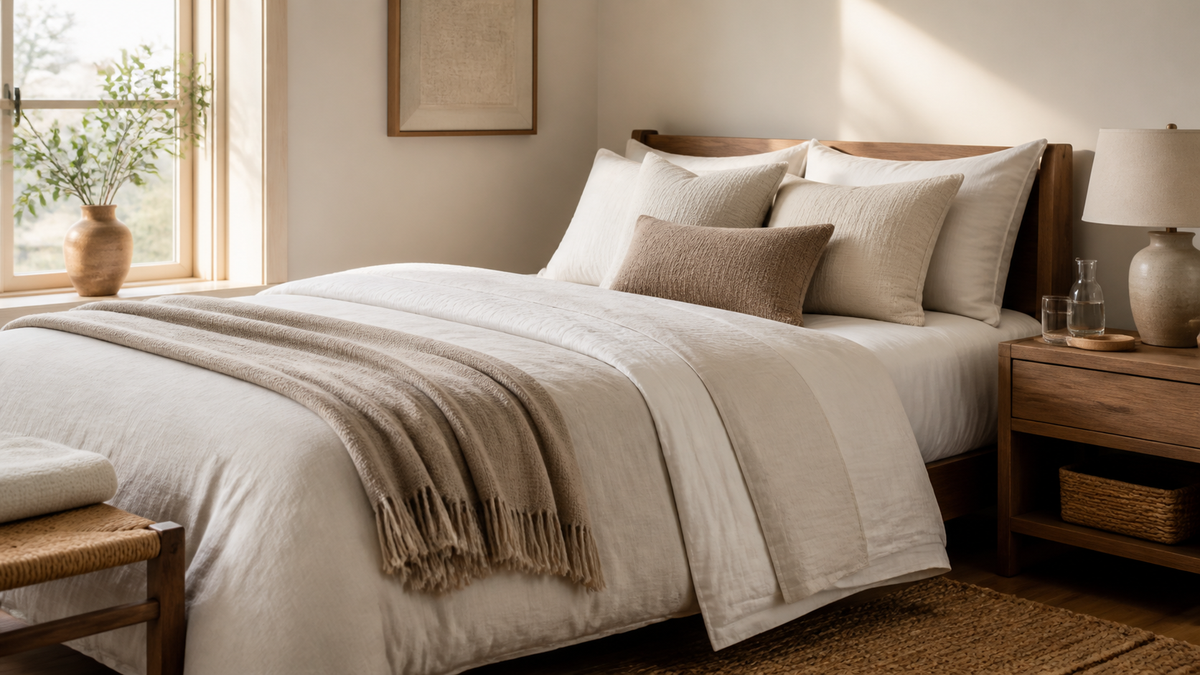
Guest Bedroom Essentials: Bedding, Pillows, Throws, and Small Comforts
If a guest room feels thoughtful, people notice before they unpack. Not because everything matches, and not because the styling is elaborate. They notice because the bed looks inviting, the layers make sense, and the room quietly answers the small questions that come up when someone is staying overnight: Will I be warm enough? Is there an extra pillow? Where do I put my bag? Can I reach a lamp and a charger without moving furniture around?
That is a useful lens for IdyllVie. The brand's home assortment already leans toward calm, tactile comfort rather than decorative excess. On Friday, August 28, 2026, the live IdyllVie blog and product pages were accessible again, and the strongest fit for this article was a guest-bedroom guide grounded in real bedding, pillow, and throw products rather than a generic hosting roundup.
The most welcoming guest rooms are built the same way the best wardrobes are built: from essentials that work hard, layer well, and do not need constant replacing. In practice, that means breathable base bedding, supportive pillows, one warmer top layer, and a short list of small comforts that help visitors settle in without asking for anything.
The Quick Answer
If you want a guest bedroom to feel polished and genuinely comfortable, focus on five essentials:
- breathable sheets and a comfortable base layer
- a duvet or insert that handles most of the night's warmth
- supportive sleep pillows plus a restrained decorative layer
- a throw or folded quilt for adjustable comfort
- small practical touches such as lighting, storage, water, and charging access
The room should feel easy to use, not overdesigned. Guests remember comfort, not styling effort.
What Guests Actually Notice First
It is easy to overestimate how much guests care about decor objects and underestimate how much they care about practical comfort. Sleep Foundation's guide to setting up a bedroom for better sleep, updated on August 11, 2026, emphasizes that a dark, quiet, comfortably cool bedroom with supportive pillows, clean bedding, and less clutter creates better conditions for quality rest. That advice applies just as well to a guest room as it does to a primary bedroom.
Architectural Digest's current guest-room guidance reaches a similar conclusion from a design angle. Its live guest-room roundup highlights plush bedding, layered lighting, practical storage, and easy-to-access outlets or charging stations as the details that make a room feel more hotel-like without becoming impersonal.
That combination matters for IdyllVie because it supports a premium but useful standard:
- the room should look calm on first impression
- the bed should offer options, not just one temperature
- the practical touches should be visible enough that guests do not need instructions
If you solve those three things, the room already feels more generous.
Start With the Bed, Not the Accessories
The bed is the center of the guest experience, so it should do most of the work. A room can have beautiful art and a lovely chair, but if the bedding feels flat, fussy, or too warm, the whole experience drops quickly.
Build the bed in layers guests can read at a glance
The best guest bed is visually simple and physically adjustable. Instead of making one heavy bedding choice and hoping it suits everyone, layer the bed so a guest can immediately tell what to pull up, fold back, or set aside.
Use a four-part structure:
- breathable sheets closest to the body
- a main duvet or insert for core warmth
- a lighter folded layer such as a quilt or coverlet for visual depth
- a throw at the foot of the bed for extra warmth or afternoon reading
This is where the current IdyllVie bedding assortment gives the article real grounding. The live product page for the Mulberry Silk-filled Duvet Insert with Luxe Cotton Shell positions it as a premium insert option, while the TENCEL Lyocell Mattress Pad Protector adds a practical layer under the sheets for comfort and easier guest-room maintenance. Those are the kinds of pieces that make the room feel considered without adding clutter.
When guests arrive, the bed should communicate flexibility. They should not have to guess whether the room runs warm or cool.

Choose breathable base materials for the layers people use most
The highest-contact layers should usually be the least complicated ones. CottonWorks' current home-textiles guidance continues to frame cotton as a strong choice for bedding because its breathability helps humidity pass through the fabric and supports a more comfortable sleep surface. That does not mean every visible layer has to be cotton, but it does mean cotton remains a reliable base for sheets, pillow covers, and lighter blankets.
For a guest room, that creates a simple rule: let the base layers feel familiar and breathable, then use more textured fibres for warmth and finish. A natural-fibre mix tends to feel premium without becoming precious.
This is also one reason guest beds often look better when the palette stays controlled. Crisp bedding in ivory, oat, sand, or warm grey makes texture easier to notice and helps the room feel restful rather than staged.
Pillows Should Solve Sleep First and Styling Second
A guest room can look polished and still be frustrating if the pillow setup is too decorative. Supportive pillows matter more than an elaborate arrangement that gets removed the moment someone wants to sleep.
Use two pillow categories, not five
The cleanest setup is usually:
- two sleeping pillows per guest, or two on each side for a larger bed
- one restrained decorative sham or accent pillow if the room needs extra texture
That is enough to make the bed feel finished without turning bedtime into a clearing exercise.
The current IdyllVie Linen Pillow Cover including Feather Inserts is useful here because it supports structure and softness without looking flashy. The Oasis Linen Throw Pillow can work on a bench or reading chair, or on the bed if the room is visually spare. The key is to avoid piling on small cushions that have no real function.
Keep the decorative layer easy to move
Good guest-room styling reduces friction. If you use a decorative pillow, make sure there is an obvious place to set it down at night, such as a bench, chair, or basket. Architectural Digest's live guidance on guest-room planning specifically calls out practical storage and places to unpack. That same thinking applies to bedding overflow too.
If the room is small, fewer pillows almost always look more refined. One sham with texture will read as more intentional than three novelty accents in competing shapes.
The Throw Is Not Optional if You Want the Room to Feel Finished
Many guest rooms are missing one thing: an extra layer that is visible, reachable, and separate from the main bedding. That is where a throw earns its place.
What a good guest-room throw should do
A throw should:
- add warmth without forcing a full bedding change
- give the bed more depth and welcome on arrival
- work for reading, napping, or early-morning lounging
- connect the guest room to the rest of the home's material palette
The current Algonquin Alpaca Wool Throw Blanket is a strong IdyllVie reference because it is substantial enough to feel like real comfort, not a token styling prop. In a guest room, a piece like that works best folded at the foot of the bed or draped over a chair where its texture is visible and its use is obvious.
Woolmark's wool-care guidance also supports the case for wool-rich layers in lower-wash, long-life uses: wool resists odour and stains naturally and does not need constant laundering. That makes it well suited to a guest-room throw, as long as care instructions are clear and fibre-appropriate.
Small Comforts Are What Turn a Spare Room Into a Guest Room
The visual layer may get the attention, but the small operational details are what make guests feel genuinely looked after.
The best guest-room comforts are practical, quiet, and easy to spot
Think in terms of the first ten minutes after someone enters the room. They need to put something down, plug something in, find water, and understand the lighting.
The most useful additions are:
- a bedside lamp or reachable reading light
- accessible charging or outlet access
- a folded towel or robe if appropriate for the stay
- a surface for water, glasses, or a phone
- a bench, stool, or luggage rack
- one drawer, basket, or open shelf for temporary storage
None of those items need to feel styled for social media. They just need to be visible, usable, and in scale with the room.
Sleep Foundation's bedroom guidance also supports keeping clutter low and layout usable. That matters in guest rooms because even a beautiful space can feel stressful if there is nowhere to set a suitcase or too many decorative objects occupying every surface.

Keep the room cohesive, not themed
One of the quickest ways to cheapen a guest room is to overstate the concept. If the palette is neutral and the textiles already provide softness, the room does not need many additional signals.
The calmest version of this formula usually includes:
- one light base tone such as ivory or oat
- one grounding neutral such as mushroom, taupe, or soft walnut
- one tactile contrast from linen, brushed wool, or quilted cotton
That palette leaves space for real product texture to stand out. It also keeps the guest room aligned with the rest of the home rather than making it feel like a temporary set.
Guest Bedroom Essentials Checklist
Use this as the practical standard for a room that needs to feel welcoming without being overfilled.
| Element | What to include | Why it matters | What to avoid |
|---|---|---|---|
| Base bedding | Breathable sheets and a comfortable mattress layer | Supports comfort through the whole night | Overly delicate bedding that feels hard to maintain |
| Main warmth layer | Duvet or insert matched to the season | Gives the room its core comfort | One overly hot bedding solution with no backup option |
| Pillows | Supportive sleep pillows plus at most one accent layer | Balances function and polish | Stacks of decorative pillows with no storage |
| Extra warmth | Folded throw or quilt | Lets guests adjust easily | Thin decorative throws that do not provide real warmth |
| Bedside setup | Lamp, water space, charging access | Removes basic friction for overnight stays | Bare nightstands or blocked outlets |
| Storage | Bench, rack, drawer, or basket | Helps guests settle in quickly | Rooms with nowhere to place bags or folded clothing |
| Visual edit | Calm palette and a few real textures | Makes the room feel intentional | Too many patterns or small decorative fillers |
A Simple IdyllVie Guest-Room Formula
If you want a direct product-led way to assemble the room, this is the clearest version:
- Start with breathable sheets and a clean base bed.
- Add a premium insert such as the Mulberry Silk-filled Duvet Insert with Luxe Cotton Shell.
- Use supportive sleeping pillows and keep decorative pillows restrained.
- Bring in linen texture through the Linen Pillow Cover including Feather Inserts or the Oasis Linen Throw Pillow.
- Finish with one substantial throw such as the Algonquin Alpaca Wool Throw Blanket.
- Add a practical bedside layer: lamp, charger access, water, and one surface for essentials.
That mix feels aligned with IdyllVie's current assortment because it combines comfort, natural texture, and a low-clutter aesthetic. It also keeps the guest room useful between visits instead of turning it into a space that only looks good in photos.
Internal Links to Add
- How to Choose the Right Duvet Insert for Your Sleep Style
- Bamboo Bedding vs Cotton Bedding: Which Feels Better for Your Sleep?
- How to Style Throw Pillows Without Making the Sofa Look Busy
- Throw Blanket Size Guide: Sofa, Bed, and Reading Chair Proportions
- Best Organic Bedding: Top Picks & Guide 2026
- Linen Pillow Cases: A Guide to Ultimate Comfort & Style
- Mulberry Silk-filled Duvet Insert with Luxe Cotton Shell
- TENCEL Lyocell Mattress Pad Protector
- Linen Pillow Cover including Feather Inserts
- Oasis Linen Throw Pillow
- Algonquin Alpaca Wool Throw Blanket
- IdyllVie Home Decor Collection
FAQ
What should every guest bedroom have?
At minimum, a guest bedroom should have breathable bedding, supportive pillows, one extra warmth layer such as a throw or quilt, a bedside light, and somewhere for guests to place a bag, phone, and water.
How many pillows should you put on a guest bed?
Usually two sleeping pillows per person is the most practical baseline. Add one decorative sham or accent pillow only if it does not make the bed harder to use.
What is the best blanket or throw for a guest room?
The best throw is one that provides real warmth and can be used independently of the duvet. Natural-fibre options with visible texture tend to feel more premium and easier to style than purely decorative layers.
How do you make a guest room feel welcoming on a budget?
Focus first on clean layered bedding, comfortable pillows, a reachable lamp, water by the bed, and a clutter-free surface. Those changes usually matter more than buying extra decor.
Should guest-room bedding be neutral?
Not always, but calm neutrals are often the easiest way to make texture stand out and help the room feel restful for different guests.
What small comforts do overnight guests appreciate most?
Lighting, charging access, water, towel placement, and a place to unpack are usually more appreciated than decorative extras.














0 comments